Open Submissions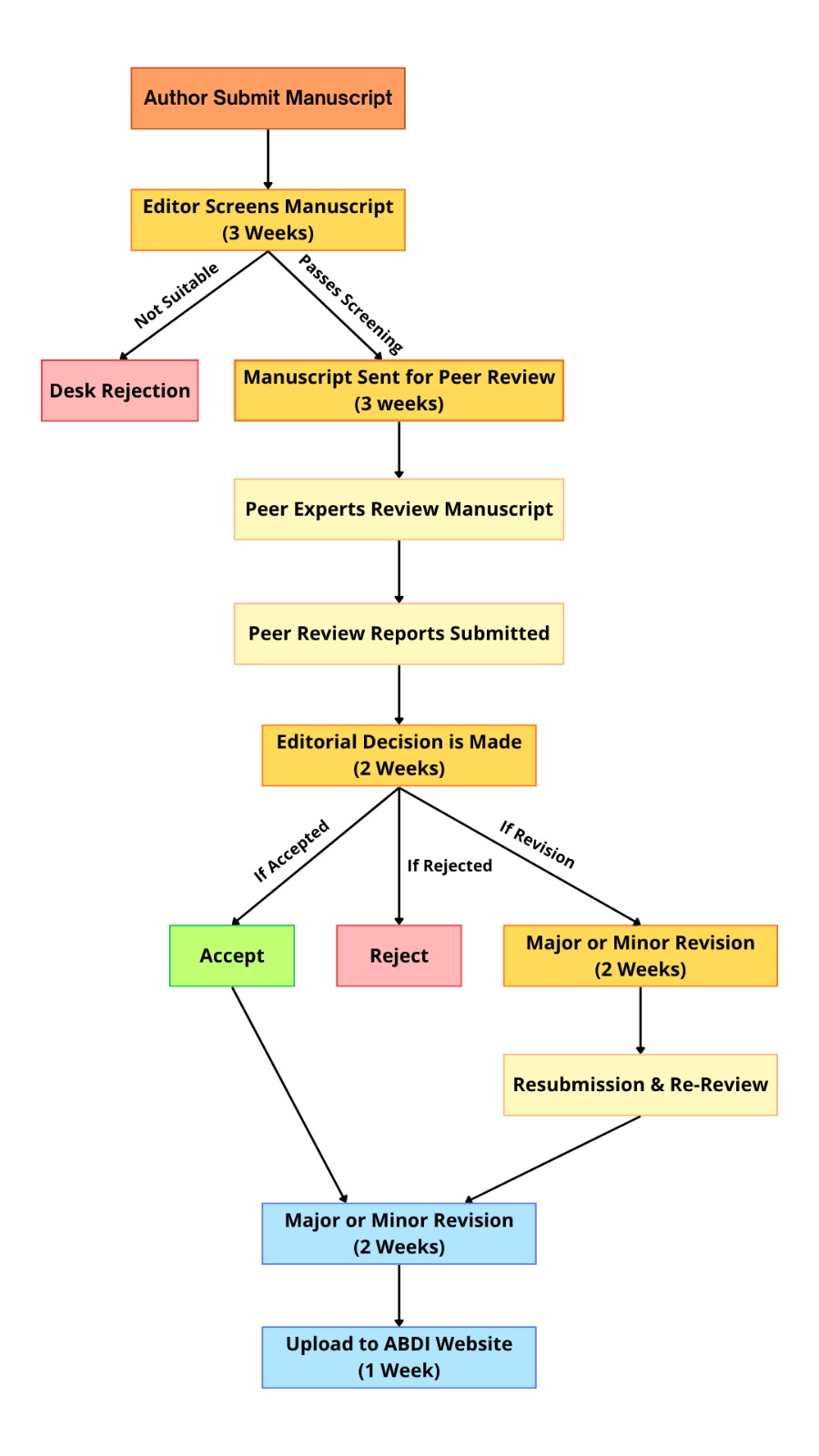
SINTA


ABDI Journal is a peer-reviewed academic journal dedicated to publishing high-impact research at the nexus of digital technology, business, and entrepreneurship. We prioritize manuscripts that demonstrate significant novelty in theoretical and empirical contributions particularly those exploring emerging fields like Orange Technology and address the urgency of challenges within the contemporary digital economy. While rooted in the dynamic digital landscape of Indonesia, ABDI Journal actively fosters a global dialogue by welcoming contributions from scholars worldwide.
The journal encourages submissions that critically examine how digital innovation can drive sustainable development. We are particularly interested in research that explores how technology-driven business models address key economic, social, and environmental challenges, aligning with the United Nations Sustainable Development Goals (SDGs)
The journal invites original, unpublished manuscripts focusing on, but not limited to, the following core areas:
1. Orange Technology and Human-Centric Innovation
Research on the convergence of digital technology with health, well-being, and the creative industries (Orange Economy), focusing on innovations that enhance human experience and societal value.
2. Digital Business Models and Transformation
Analysis of the strategic integration of digital technologies to innovate and transform business processes, value propositions, and organizational structures.
3. Digital Entrepreneurship and Innovation Ecosystems
Research on the creation, growth, and management of new ventures within the digital ecosystem, including studies on digital platforms and startup dynamics.
4. Emerging Technologies in Management
Examination of the strategic application of technologies such as Artificial Intelligence (AI), Blockchain, Big Data Analytics, and the Internet of Things (IoT) on organizational performance and competitive advantage.
5. Digitalization for Sustainable Development
Exploration of how digital technologies can be leveraged to address global challenges through innovations in circular economies, inclusive growth, and responsible corporate practices.
6. Data Governance and Digital Ethics
Critical examination of the frameworks, policies, and ethical considerations governing data in business, including topics on information privacy, algorithmic bias, and corporate digital responsibility.
By concentrating on these pivotal areas, ABDI Journal aims to advance critical scholarly conversations and provide actionable insights for both academic theory and managerial practice in the global digital economy.
ADI Bisnis Digital Interdisiplin (ABDI Jurnal) is committed to maintaining a rigorous, fair, and constructive peer-review process to ensure the quality and integrity of published research. All submitted manuscripts are evaluated through a structured editorial process that considers their relevance to the journal's focus and scope, compliance with manuscript guidelines, scientific quality, originality, and contribution to the development of knowledge in the fields of digital business, technology, entrepreneurship, and related areas.
The peer-review process at ABDI Jurnal consists of the following stages:
1. Manuscript Eligibility Assessment
Upon submission, each manuscript is first examined by the editorial team to determine whether it is suitable for further consideration. This assessment covers the manuscript's alignment with the journal's focus and scope, adherence to the prescribed manuscript template and writing guidelines, completeness of the submission, and general academic quality.
At this stage, the editorial team may return the manuscript to the author for preliminary corrections or decline the submission when it does not satisfy the journal's fundamental requirements. Manuscripts that fulfill the initial requirements are forwarded to the peer-review stage.
2. Reviewer Selection and Confidential Evaluation
Manuscripts that are considered eligible for review are assigned to at least two independent reviewers with relevant academic expertise. ABDI Jurnal applies a double-blind peer-review system, in which the identities of both authors and reviewers are kept confidential throughout the evaluation process.
Reviewers are expected to assess the manuscript objectively and provide constructive recommendations. The evaluation considers, among other aspects, the originality of the work, its scientific contribution, methodological and analytical quality, relevance to the journal's scope, and clarity of presentation. Reviewer comments are used to identify the strengths of the manuscript as well as aspects that require improvement.
3. Editorial Consideration
Following the completion of the review, the editorial team examines the reviewers' recommendations together with the manuscript's overall quality and compliance with the journal's standards. The editorial decision is not based solely on a single reviewer's recommendation but considers the review reports collectively and the academic judgment of the editorial team.
Based on this evaluation, ABDI Jurnal may issue one of four decisions:
4. Author Revision and Further Evaluation
When revisions are requested, the corresponding author is expected to address the reviewers' comments carefully and revise the manuscript accordingly. Authors should ensure that substantive changes are appropriately incorporated into the revised manuscript and that the concerns raised during the review process are adequately addressed.
A revised manuscript may be evaluated again by the editorial team and, where necessary, returned to the reviewers for further assessment. The revision process may continue until the manuscript either satisfies the required standards for publication or is determined not to meet the journal's requirements.
5. Final Acceptance and Publication
A manuscript is considered ready for publication only after the required review and revision stages have been satisfactorily completed and the editorial team has confirmed its compliance with ABDI Jurnal's academic, ethical, and editorial standards.
Following final acceptance, the manuscript proceeds to the final editorial preparation, including copyediting, proofreading, formatting, DOI assignment, and online publication. Accepted manuscripts are published in accordance with the journal's publication schedule and made available through the official ABDI Jurnal platform.
Through this process, ABDI Jurnal seeks to ensure that every published article demonstrates originality, scientific contribution, academic rigor, and clear presentation, while maintaining confidentiality, fairness, and integrity throughout the peer-review and editorial process.
ABDI Jurnal publishes biannually, scheduled for June and December. Manuscripts may be submitted at any time throughout the year, and accepted papers will be included in the nearest upcoming issue according to the editorial workflow.
Each issue of ABDI publishes approximately 10 peer-reviewed articles, amounting to about 20 articles annually. The editorial process (https://adi-journal.org/index.php/abdi/EditorialPolicies/#EditorialandEditingProcess) follows the Standard Operating Procedure (SOP), which ensures rigorous peer review and transparent editorial management.
Following submission, manuscripts are screened by the editors within 3 weeks. Eligible manuscripts proceed to peer review by subject experts, typically completed within another 3 weeks. Peer review reports are evaluated by the editorial team, and an editorial decision is usually communicated within 2 weeks. In cases where revisions are required, authors are provided 2 weeks to resubmit. Final accepted papers are uploaded and published online according to the scheduled issues (June and December).
This structured process ensures timely, transparent, and fair editorial management, fully aligned with the journal’s commitment to academic integrity and quality.
Authors have the option to publish open access in this journal through our Open Select publishing program. By choosing to publish open access, your article will be freely available worldwide immediately upon publication, which can increase the visibility, readership, and impact of your research.
If your research funder or institution requires you to publish open access, please refer to our guidelines for compliance. To make your article open access, an article publishing charge (APC) will apply. This cost is often covered by your institution or funder. Please refer to our APC finder for more details regarding the APC for this journal.
For further details, please visit our Author Services website to learn more about our Open Select Program.
This journal utilizes the LOCKSS and CLOCKSS system to create a distributed archiving system among participating libraries and permits those libraries to create permanent archives of the journal for purposes of preservation and restoration.
ADI Bisnis Digital Interdisiplin (ABDI Jurnal) is a peer-reviewed open-access journal. This statement clarifies the ethical behavior of all parties involved in the act of publishing an article in this journal, including the author, the chief editor, the Editorial Board, the peer-reviewer and the publisher (Sinar Mentari Sundara). This statement is based on the previous COPE’s Code of Conduct and Best Practice Guidelines for Journal Editors and the current COPE's Core Practices.
Ethical Guideline for Journal Publication
The publication of scholarly articles in the Journal of ADI Bisnis Digital Interdisiplin (ABDI Jurnal), a peer-reviewed journal, plays a pivotal role in establishing a coherent and esteemed knowledge network. This process serves as a direct representation of the authors' work and the institutions endorsing them, contributing to the advancement of scientific understanding. Peer-reviewed articles within ABDI serve as a manifestation of the rigorous scientific method. As such, it is imperative to establish and adhere to standardized ethical principles for all stakeholders involved in the publication process: the author, the journal editor, the peer reviewer, the publisher, and the society at large.
Duties of Authors
Authors of reports of original research should present an accurate account of the work performed as well as an objective discussion of its significance. Underlying data should be represented accurately in the paper. A paper should contain sufficient detail and references to permit others to replicate the work. Fraudulent or knowingly inaccurate statements constitute unethical behaviour and are unacceptable.
Authors are asked to provide the raw data in connection with a paper for editorial review, and should be prepared to provide public access to such data (consistent with the ALPSP-STM Statement on Data and Databases), if practicable, and should in any event be prepared to retain such data for a reasonable time after publication.
The authors should ensure that they have written entirely original works, and if they have used the work and/or words of others, this has been appropriately cited or quoted.
An author should not generally publish manuscripts describing essentially the same research in more than one journal or primary publication. Submitting the same manuscript to more than one journal concurrently constitutes unethical publishing behavior and is unacceptable.
Proper acknowledgement of the work of others must always be given. Authors should cite publications that have been influential in determining the nature of the reported work.
Authorship should be limited to those who have made a significant contribution to the conception, design, execution, or interpretation of the reported study. All those who have made significant contributions should be listed as co-authors. Where there are others who have participated in certain substantive aspects of the research project, they should be acknowledged or listed as contributors. The corresponding author should ensure that all appropriate co-authors and no inappropriate co-authors are included on the paper and that all co-authors have seen and approved the final version of the paper and have agreed to its submission for publication.
All authors should disclose in their manuscript any financial or other substantive conflict of interest that might be construed to influence the results or interpretation of their manuscript. All sources of financial support for the project should be disclosed.
When an author discovers a significant error or inaccuracy in his/her own published work, it is the author’s obligation to promptly notify the journal editor or publisher and cooperate with the editor to retract or correct the paper.
Duties of Editors
Editors evaluate submitted manuscripts exclusively on the basis of their academic and intellectual merit, without regard to the author's race, gender, sexual orientation, ethnic origin, citizenship, religious belief, political philosophy, or institutional affiliation. Decisions to edit and publish are not determined by the policies of governments or any other agencies outside of the journal itself. The Editor-in-Chief has full authority over the entire editorial content of the journal and the timing of publication of that content.
Confidentiality:
Editors and editorial staff will not disclose any information about a submitted manuscript to anyone other than the corresponding author, reviewers, potential reviewers, other editorial advisers, and the publisher, as appropriate.
Editors and editorial board members will not use unpublished information disclosed in a submitted manuscript for their own research purposes without the authors' explicit written consent. Editors will recuse themselves from considering manuscripts in which they have conflicts of interest resulting from competitive, collaborative, or other relationships/connections with any of the authors, companies, or institutions connected to the papers.
The editors are responsible for deciding which of the manuscripts submitted to the journal will be published. They are guided by the journal's editorial board policies and constrained by legal requirements regarding libel, copyright infringement, and plagiarism. The editors may confer with other editors or reviewers in making this decision.
Editors will take responsive measures when ethical complaints have been presented concerning a submitted manuscript or published paper. This includes communicating with the author and giving due consideration to the complaint, but may also include communications with relevant institutions and research bodies. If the complaint is upheld, the journal will publish a correction, retraction, expression of concern, or other note, as may be relevant.
Duties of Reviewers:
Peer review assists the editor in making editorial decisions and through the editorial communications with the author may also assist the author in improving the paper.
Any selected referee who feels unqualified to review the research reported in a manuscript or knows that its prompt review will be impossible should notify the editor and excuse himself from the review process.
Any manuscripts received for review must be treated as confidential documents. They must not be shown to or discussed with others except as authorized by the editor.
Reviews should be conducted objectively. Personal criticism of the author is inappropriate. Referees should express their views clearly with supporting arguments.
Reviewers should identify relevant published work that has not been cited by the authors. Any statement that an observation, derivation, or argument had been previously reported should be accompanied by the relevant citation. A reviewer should also call to the editor's attention any substantial similarity or overlap between the manuscript under consideration and any other published paper of which they have personal knowledge.
Privileged information or ideas obtained through peer review must be kept confidential and not used for personal advantage. Reviewers should not consider manuscripts in which they have conflicts of interest resulting from competitive, collaborative, or other relationships or connections with any of the authors, companies, or institutions connected to the papers.
Duties of the Publisher (Sinar Mentari Sundara)
Pandawan, as the publisher of ABDI Jurnal, is committed to ensuring that best practices in scholarly publishing are strictly followed.
Pandawan Sejahtera Indonesia takes responsibility for maintaining the integrity of the scholarly record. The publisher collaborates closely with the journal editors to address any ethical concerns, issue corrections or retractions when necessary, and ensures that any potential for advertising, reprint, or other commercial revenue has no impact or influence on editorial decisions.
Pandawan Sejahtera Indonesia is committed to the editorial independence of the ABDI Jurnal team and guarantees that editors are free to make publication decisions based solely on academic merit.
Authors publishing open access are encouraged to deposit the final published PDF in their institutional repository or any suitable subject repository on publication. Authors should provide a link from the deposited version to the URL of the published article on the journal's website; in all cases, the requirement to link to the journal’s website is designed to protect the integrity and authenticity of the scientific record, with the online published version on the journal’s website clearly identified as the definitive version of record.
ADI Bisnis Digital Interdisiplin (ABDI Journal) charges the following author fees:
Article Submission Fee: USD 100,000 (USD)
Authors are required to pay an Article Submission Fee as part of the submission process to contribute to the costs associated with the manuscript review process.
Article Processing and Publication Fee: USD 100,000
To support the costs of providing open access to published research and to cover various expenses associated with manuscript handling, editing, journal management, and publication, authors or their affiliated institutions are required to pay an Article Processing and Publication Fee for each accepted article.
The fee includes:
- The standard manuscript length is twelve (12) pages. An additional fee of USD 100,000 per page will be charged for each page exceeding the standard length.
- DOI registration for each manuscript.
- Article similarity checking using Turnitin, the final similarity report will be provided to the authors upon request.
- Layout editing in accordance with the journal's template and publication standards.
Fee Waiver or Reduction A partial waiver or reduction of the author fees may be granted at the editor's discretion in cases of financial hardship, excessive manuscript length, or other reasonable circumstances stated by the author. Authors requesting a fee waiver or reduction must clearly indicate their request in the Comments for the Editor field during the submission process. Requests submitted after this stage may be less likely to be considered. The approval or rejection of a fee waiver request will not affect the outcome of the manuscript review process.
|
|
ADI Bisnis Digital Interdisiplin (ABDI Jurnal)
|


 .
.